AI Ad Copy Generator: How to Craft Perfect Ad Copies with AI
Learn how an AI ad copy generator works and how to use it to create persuasive ad headlines, compelling product messages, and high-converting calls to action in minutes.

A good product with substandard descriptions rarely generates sales as the descriptions attract the consumers when they cannot actually test the product. Now, the question is how to create an irresistible ad copy.
Well, the AI ad copy generator is here to help you craft the perfect ad copies without much effort. Its simple commands and quick processing lead to flawless ad copies.
The tool takes the target audience, your goals, and expected results into consideration for generating the perfect ad copy with ease. Let us learn how it can help you with your ad copy creation tasks.
Why Use an AI Ad Copy Generator?
Efficiency
Production of ad copies may be time-consuming. Whether it is to develop eye-catching headlines or a call to action, a careful thought process is involved in each step. It is even more hectic to generate more than one copy for a single product.
An AI ad generator can help reduce this time drastically. You can easily generate multiple copies in various formats within minutes.
Cost Reduction
For scaling a business, it is important to create appealing ad copies. This results in the hiring of professional teams or copywriters. Consequently, the production price of a product is further escalated.
AI ad copy generators minimize the necessity to employ costly marketing teams, which helps small enterprises to conduct their advertising campaigns more cost-effectively.
Customized Ads
AI Ad copy generators allow users to create personalized ads tailored to different needs. You are able to investigate your audience statistics and generate numerous advertisements per industry within minutes.
You can make your advertisements more relevant to potential customers by producing Ad copies that are in line with the interests of your target audience.
Multi-language Support
Do you want to grow your business globally? Rather than contracting professional translators or copywriters outside your local region, try an AI ad copy generator.
It can assist you in creating ad copies in various languages and reach the whole world. In this way, you can go international while operating from your local market.
Maintains Consistency
Maintaining consistency is the key to creating your brand identity. An Ad AI generator helps a brand ensure a uniform brand voice across every platform. It can generate ad copies in a consistent tone and style that flawlessly connect the advertisement with the brand.
Experiment with Different Ideas
Cannot decide between two concepts to generate an ad copy for a product? Creating multiple ad copies manually to experiment with different concepts can be time-consuming. Simply use an AI Ad generator to experiment with different ideas more efficiently.
Starting with the simple titles and moving on to the dramatic headlines, the tool can create various variations and you can select the most appropriate concept.
How to Use an AI Ad Copy Generator: Step-by-Step
Step 1: Define Your Goals
The tool of the Ad Copy Generator requires that you be explicit regarding your goals. For this, the most important thing to find is:
The aim of the Ad Copy Generator tool. It may be gaining website traffic or increasing your product sales, or just enhancing the awareness of your brand.
Step 2: Find Target Audience
The next thing to identify is your target audience. Here is how:
It is essential to be aware of the unique selling point of your product first to identify the audience who can benefit from your business.
Conduct comprehensive marketing research and identify your competitors, the audience they are addressing, and the customer demographics that they are aiming at.
Begin listing the characteristics of your target audience, including age, interests, hobbies, income level, and pain points.
And finally, survey your current customers and see what they need and expect of your brand.
Step 3: Search Relevant Keywords
Then, you must know the relevant keywords of your industry before generating an SEO-friendly Ad copy. It helps your product rank higher in search engines and enhances click rates. To search relevant keywords:
You must first be clear about the purpose of your product, the relevant industry, target region, and customer demographics.
Question yourself about what you will search for as a customer for your product to show up as a solution.
Find the keywords of your competitors by analyzing their product descriptions, headings, and titles used.
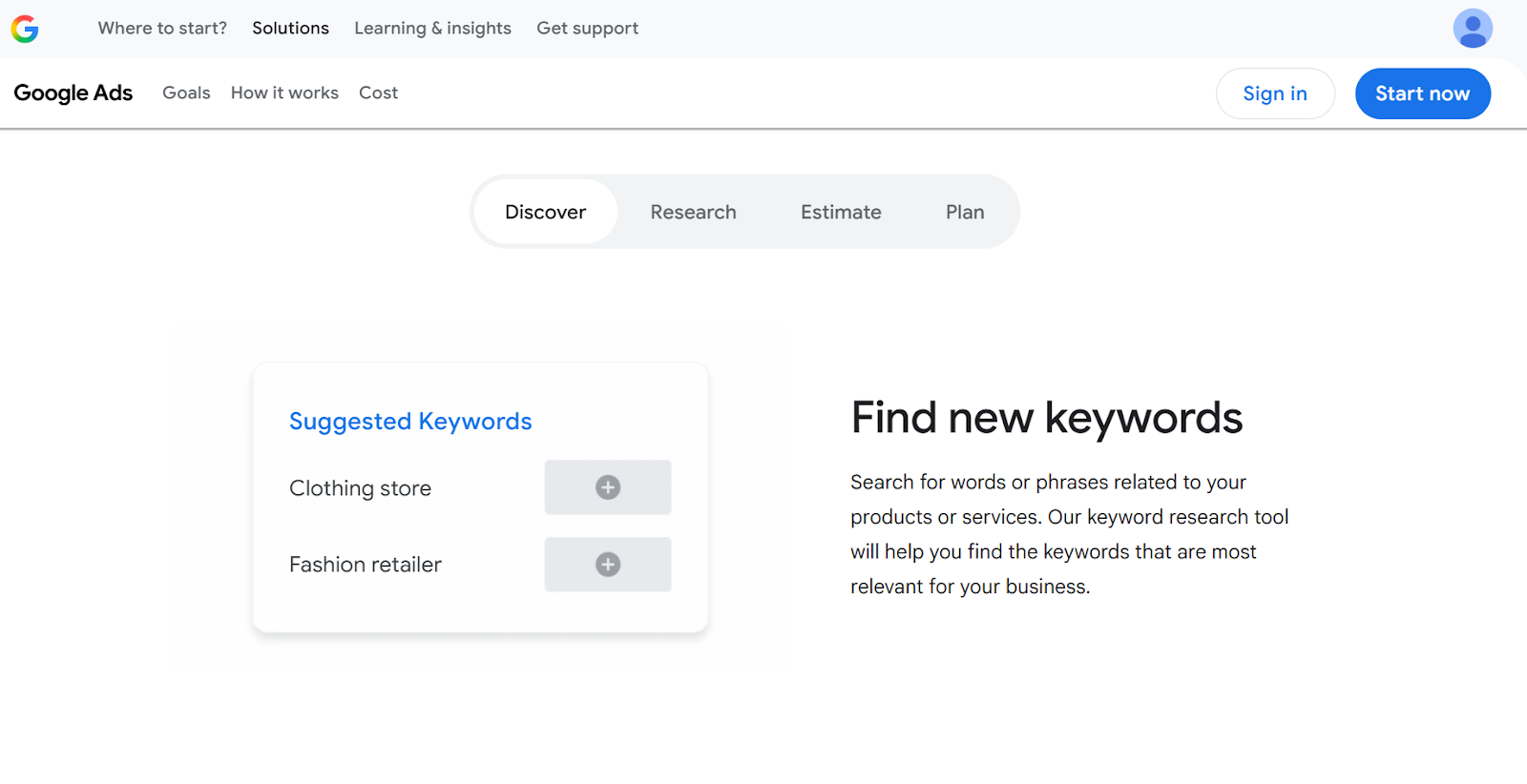
You can also use tools like Google Planner to find long and short-tail keywords and use both in generating an Ad copy.
Step 4: Provide a Strong Input
Once you are clear about your target audience and have sorted the relevant keywords, the next phase is Ad copy generation using an AI tool. For this:
Open the AI Ad copy generator and head to the prompt box.
Add details about the output you want. The details include information about your target audience and region, your product benefits, key features, tone, and finally, the platform where you will be sharing it.
For example,
“Generate an Ad copy for Instagram that promotes assistant robots for people living in old-age homes. The robot helps with different things like cleaning, organizing, and bringing things to the elders. It can also make conversations with people. The tone should be professional and engaging.”
Step 5: Generate Variations, Optimize, and Download
Prompt the AI to generate multiple ad variations based on different headlines, varying call-to-action lines, and unique description styles.
Review the ad copy and optimize it to ensure clarity.
Finally, download the ad copy.
How to Generate a High-Converting Ad
Before using AI for generating Ads, you must know about the key elements of a an ad copy. By ensuring that the copy contains all the important parts, you can generate a high-converting ad successfully. Here is the further breakdown:
Focus on Headlines
Your headline must be clear and concise. It is the most important part of the ad copy that will make the viewers decide to stay or scroll past your product. An engaging headline must focus on the pain point of the target audience, along with a solution.
You can also add some numbers to specify the benefit of your product. For example, you can use headlines like “Tired of body odor in summer? Try this deodorant to eliminate body odor within 10 seconds.”
Mention Product Benefits
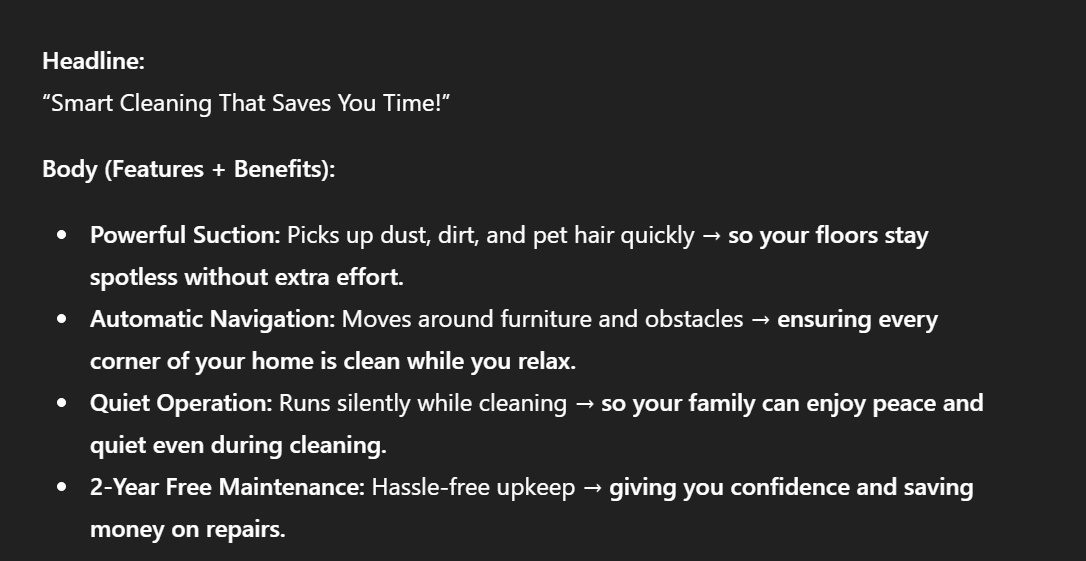
Instead of simply mentioning the features of a product, add how these features can benefit the users. For instance, instead of simply listing “24-hour battery life”, you can go for a description like “A robot that can work the whole day without requiring frequent recharges."
Such small changes make your product look beneficial and encourage the audience to buy it.
Use Emotional Triggers
Emotional triggers create a sense of urgency in the viewers, prompting them to avail your product quickly.
For instance, instead of simply listing “a responsive robot that can talk and respond”, you can go for a description like “A responsive robot that can listen to your worries when no one else does.”
Add Call to Action
Do not rely on product benefits or features to make a compelling ad copy. Rather than generic conclusions, add a call-to-action that shows users how buying the product can be beneficial for them.
For instance, go for CTAs like “sign up to our app and avail our code to get 20% off, or Buy the product today and get free services for 2 years.”

Tips for Generating the Best Ads with AI
Follow these tips to generate captivating ad copies using an AI tool:
Test Different Variations: Try a variety of variations to determine which ad will be the most appealing to your customers. An AI tool is able to create variants of an ad copy in the same time required to produce one copy.
Do not Overlook Audience Insights: Audience insights include demographics, interests, pain points and behavior patterns. These can be used to create messages that are personalized to attract and inspire interaction.
Combine AI and Human Creativity: Do not be dependent on AI only. Write the Ad copy using AI and optimize it manually. You may also add some personalized creative points in the prompt you provide to AI so that it may generate a customized copy for you.
Avoid Using Vague Prompts: With a vague input, AI produces repetitive content. Provide detailed points and add all the important factors to achieve an ad copy that actually converts.
Conclusion
AI copy generators are here to help you turn the hours of work into minutes. However, it can turn from a work of art into a big mess when you do not know how to use it properly.
Thus, ensure that your goals, target audience, and keywords are accurate to create an ad copy with a strong impact. Also, provide a detailed input. We discussed each of these steps in detail to help you experience the magic of our AI copy ad maker tool. Lastly, follow the tips to make the ad copy appear realistic and practical.
Related articles
How to Use an AI Ad Copy Generator to Create High-Converting Ads

100+ Free Stable Diffusion Prompts to Generate Amazing AI Art

15 Top AI Art Generators to Create the Best Masterpieces

35 AI Image Prompt Examples: How to Get Outstanding AI Images

5 Free AI Random Image Generators—Generate Unique Images Instantly Online

5 Tools to Extract & Convert Images to Text
6 Free Art Prompt Generators

60+ AI Art Styles to Transform Your Prompts into Masterpieces

8 Best Image-to-Image AI Generators: Transform Existing Photos with AI

How to Turn Any Sketch into a Digital Image Using AI

Image to Drawing with AI for Sketches, Line Art, and Illustrations

Most Popular AI Art Examples!

How to Write AI Art Prompts to Get Desired Results?

12 Trusted Green Logo Examples Used by Successful Brands
20 Best Lettermark (Monogram) Logos in the World

2D Animation vs. 3D Animation: A Detailed Guide for 2026

2D logo vs 3D logo: Which One is More Impactful for Branding

45 Brand Color Palette Examples To Consider For Businesses

50 Famous Logos in the World and What Makes Them Timeless
9 Types of Logos You Must Know Before Designing

How to Create a Logo for Bakery Business

9 Best AI Tools for Graphic Design

8 Best AI Interior Design Tools to Redefine Your Living Space

7 Best AI Packaging Design Tools to Transform Your Brand

7 Best Bar Interior Design Ideas for a Modern Look

14 Best Café Interior Design Ideas to Maximize Your Space and Brand
25 Best Fashion Logos We've Ever Seen and the AI That Creates Logos

Best Poster Design Ideas: Creative Concepts and AI Tools for 2026

9 Best AI Poster Design Tools to Try in 2025

Best Restaurant Logo Design Ideas to Make Your Brand Stand Out

30 Best Restaurant Logos We've Ever Seen and How to Create Yours

Best YouTube Logo Makers

Choosing the Right Logo Font Generator for Your Business Style

Combination Logo: Everything A Brand Must Learn About This Powerful Logo Type

Emblem Logo That Tells Your Brand Story
Flyer vs. Brochure vs. Leaflet: What’s the Difference?

Replicate Any Poster You Love Instantly

How to Instantly Create Free Store Logo Mockups

How to Design a Good Advertising Poster

An In-Depth Guide on How to Make a Photography Logo

How to Create Logos For a Hair Salon?

How to Choose the Perfect Poster for Your Bedroom

How to Create Logos for a Barber Shop

How to Create Logos for Websites

How to Create Restaurant Logos That Attract Customers

How to Create Iconic Wedding Logos with AI

How to Design a Logo? Learn the Quick & Easy Steps

How to Design a Personal Logo? A Complete Guide!

How To Design an Abstract Logo For Your Brand

How to Design a Logo for Your Coffee Shop: Tips, Tools, and Ideas
How to Draw a Logo Easily: From Start to Finish

How to Make a Movie Poster That Grabs Attention in Seconds

How Wordmark vs. Lettermark vs. Brandmark Shapes Visual Identity

Human vs. AI in Design: Who Really Creates Better Art?
Logo Color Meanings and How to Choose the Best Color For Your Brand

Latest Logo Design Trends for 2026 Every Brand Should Follow

Mascot Logo: An In-Depth Guide a Brand Must Check

The Difference Between Motion Graphics and Animation: A Detailed Analysis

Pamphlet vs Brochure: A Complete Guide for Modern Businesses

Poster vs. Flyer: Key Differences Every Marketer Should Know

The Ultimate Guide to Remove Shutterstock Watermarks from Images

The Complete Wordmark Logo Design Guide

What is the Difference Between Graphic Design and Animation: A Detailed Guide for Beginners
What Are the Top Sources for Logo Design Inspiration

The Ultimate Guide For Restaurant Interior Design

What Is a Pictorial Mark Logo and 30 Famous Examples
What Makes a Good Logo? Tips, Rules, and More

What Makes a Good YouTube Thumbnail That Stops the Scroll