
Facebook Marketing Strategy 2026: A Complete Guide to Grow Your Business
Discover proven Facebook marketing strategies to boost engagement, attract the right audience, and convert clicks into loyal customers, without wasting ad spend.


Most businesses post on Facebook without a clear system. The result is inconsistent reach and no way to tell what is working. A solid Facebook marketing strategy ties your content, targeting, and ad spend into one repeatable process. This guide covers organic content, paid campaigns, community building, and the metrics that show you what to do next.
Is Facebook Marketing Still Worth It in 2026?
Facebook's audience size and who it still reaches
Facebook crossed 3 billion monthly active users in 2024 and has held that scale into 2026. No other platform covers that range of age groups in one place. Reels pull in younger viewers. The core feed still drives purchases among 35 to 65 year olds. For businesses targeting more than one age group, that combination is hard to find elsewhere.
Facebook Page organic reach averages 1–6% of followers in 2026. That number has not improved. What has changed is where the reach lives. Facebook Groups consistently reach 20–40% of members per post. A Page with 10,000 followers reaches 100–600 people organically. An active Group with 10,000 members reaches 2,000–4,000. That gap is the strategic reason to build a Group alongside your Page, not instead of it.
Search behavior on Facebook has grown too. Users now look up local businesses, product reviews, and group recommendations inside the app. That makes it a discovery channel, not just a social one. A Facebook marketing strategy for small business needs to account for that shift.
How Meta's automation changes the work required
Meta's Advantage+ system handles targeting and creative decisions automatically. It tests audience segments, adjusts placements, and moves budget toward what is converting. Smaller teams without a media buyer can now reach results that used to require more expertise. The tradeoff is less manual control, but on most small accounts the automation outperforms manual setup.
Meta's AI tools also flag underperforming ads earlier than most manual reviewers would catch them. That means less wasted spend in the early stages of a campaign.
Content Strategy: Balancing Value and Promotion
Why does video get more organic reach than other formats
Reels consistently outperform other formats for organic reach on Facebook. New pages that post Reels in their first few weeks tend to see stronger initial distribution than those that rely on static posts. Watch time and shares are the signals the algorithm uses to decide how far to push a Reel. Getting to 50% average watch time in the first hour puts a video on a different distribution path than most viewers skip.
Live video works differently. It sends notifications to followers who have previously engaged with your page. That bypasses the standard feed algorithm. Regular live sessions build a routine. Your audience shows up because they know when to expect you.
Which format to use and when
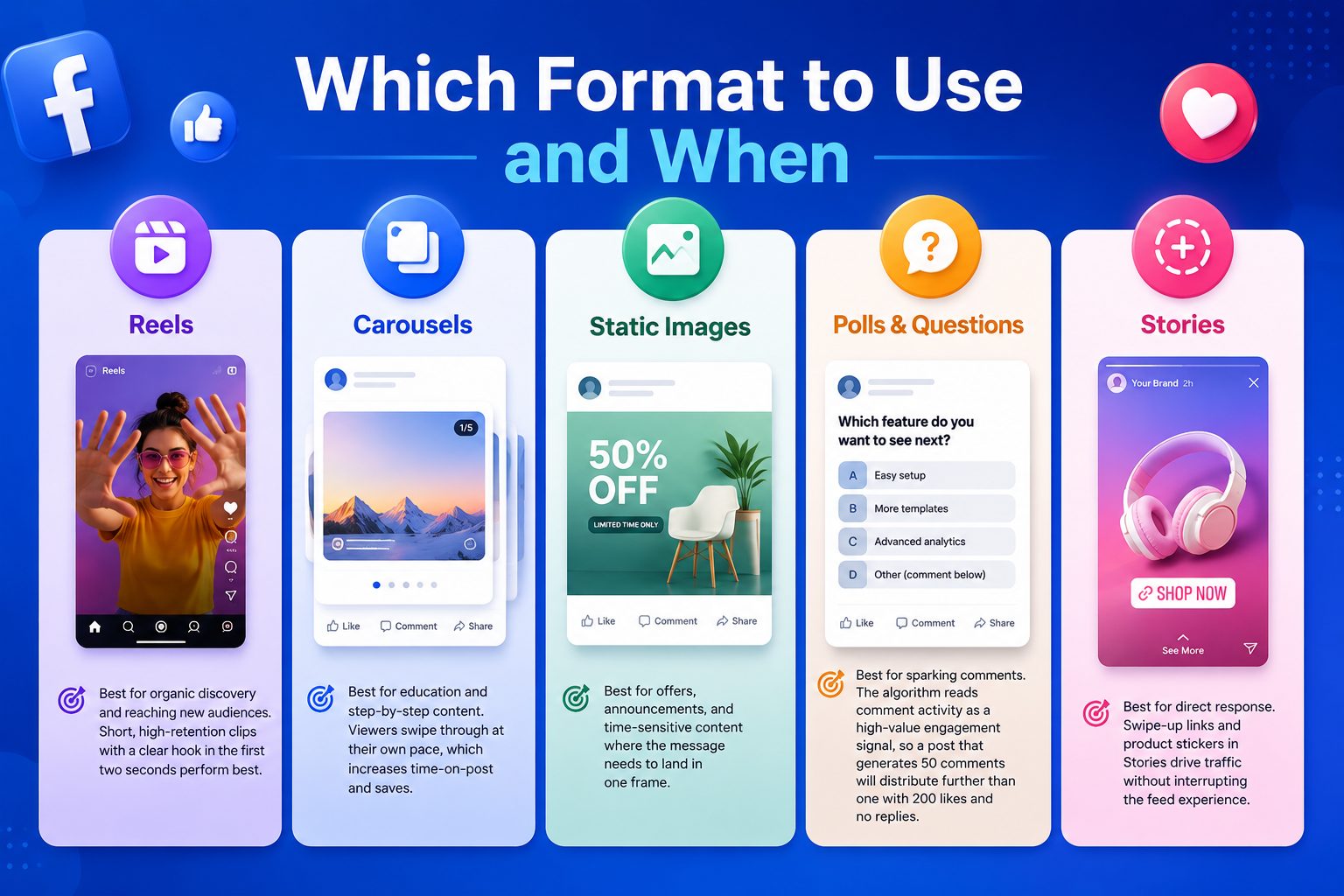
Different formats serve different purposes in a Facebook marketing strategy.
-
Reels: Best for organic discovery and reaching new audiences. Short, high-retention clips with a clear hook in the first two seconds perform best.
-
Carousels: Best for education and step-by-step content. Viewers swipe through at their own pace, which increases time-on-post and saves.
-
Static images: Best for offers, announcements, and time-sensitive content where the message needs to land in one frame.
-
Polls and questions: Best for sparking comments. The algorithm reads comment activity as a high-value engagement signal, so a post that generates 50 comments will distribute further than one with 200 likes and no replies.
-
Stories: Best for direct response. Swipe-up links and product stickers in Stories drive traffic without interrupting the feed experience.
Content mix: How much to promote vs. how much to teach
Post promotional content more than 20% of the time and engagement drops. Audiences tune out a feed that reads like a product listing. Mixing in consistent value-driven content first means the promotional posts land in a context where the audience actually trusts you enough to read them.
The 80% is not filler. It means content that solves a real problem or answers a real question in your niche. A home improvement brand posting renovation tips builds the context that makes their product posts land.
This applies equally to a Facebook group marketing strategy. Groups that become too promotional get abandoned. Groups that lead with useful discussions and periodic product mentions tend to grow through word of mouth.
Avoid external links in the post body. The algorithm deprioritizes posts that send users off-platform. Place links in the first comment instead, or use Facebook-native features like product tags and lead forms to capture conversions without leaving the app.
Facebook shops and in-feed product tagging
Facebook Shops lets you build a storefront inside your page and tag products in Reels and feed posts. When someone taps a product tag, they land on a product page inside Facebook. They never leave the app. That reduced friction directly affects conversion rates.
Setting up a Shop requires linking a product catalog through Meta Commerce Manager. After that, adding product tags to a post takes under two minutes. Pay attention to which products get tapped most from which formats. That click data tells you what your audience actually wants to buy, which should influence what you post next.
For a Facebook marketing strategy for real estate, Shops are less relevant. But the same logic applies. Tag a property in a Reel, link it to a Messenger lead form, and capture inquiries without sending the viewer to a website.
Tools for managing content volume
Content volume is a real constraint for small teams. Posting five to seven times a week across multiple formats requires either a large team or a faster production process. Several tools address this.
Canva handles static image design and has Facebook post templates built in. AI tools like ChatGPT and Gemini can generate text. Buffer and Hootsuite manage scheduling and give you a calendar view of your posting frequency. For video, CapCut handles Reels editing with caption generation. Adobe Express works for branded graphics without a full design background.
If there were a tool that could not only analyze brand strategy but also automatically generate images, videos, and written content based on the brand positioning, it would greatly improve content production efficiency while keeping the overall brand marketing more consistent in style, logic, and messaging.
Zawa social media post generator fits into the production process at the point where most time gets lost: deciding what the post looks like and what it says at the same time. For teams posting across multiple formats consistently, that removes a round of back-and-forth between writing and design.
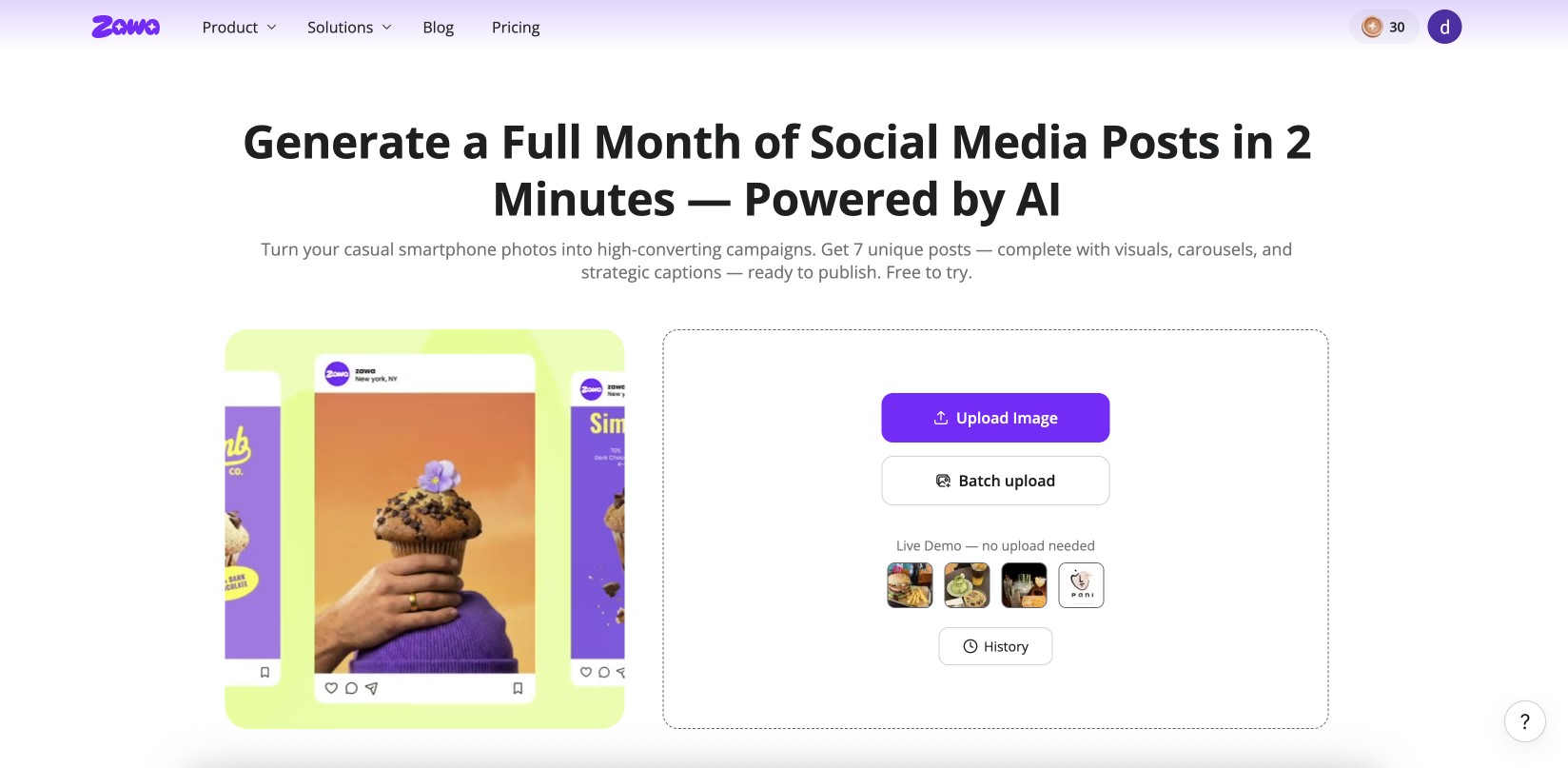
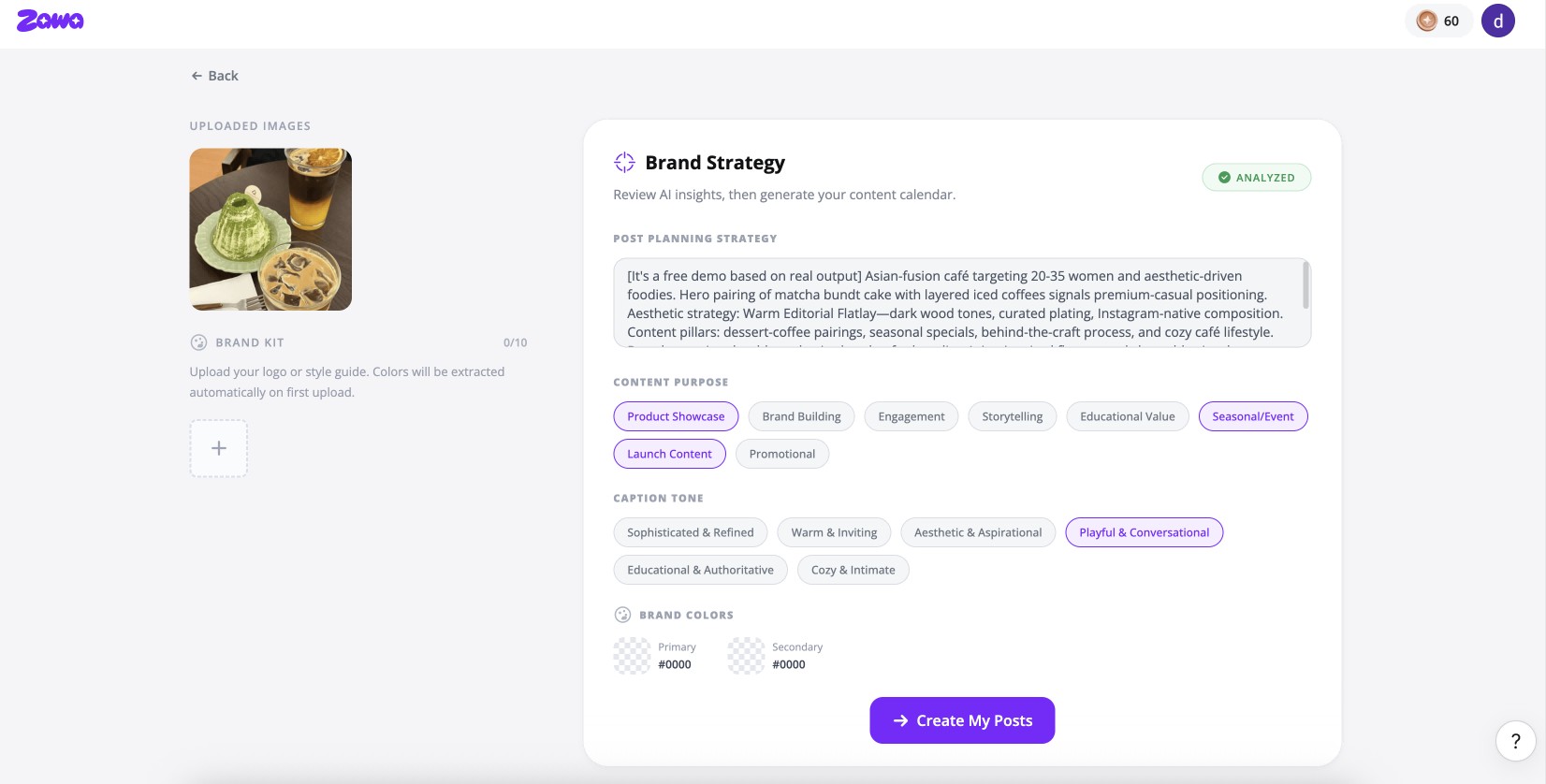
Upload one image and Zawa analyzes it to generate a brand strategy: it identifies the target audience, suggests content pillars, recommends caption tone, and extracts brand colors automatically. From there, you select the content purpose (product showcase, brand building, seasonal, and others) and the caption tone that fits your brand voice.
Hit "Create My Posts" and Zawa generates a full set of ready-to-use visuals: feed posts, carousels, infographics, and menu-style layouts, all themed consistently around your product and the brief it built from your image. Each post comes with its own caption and hashtags. You download what you need and skip the rest.
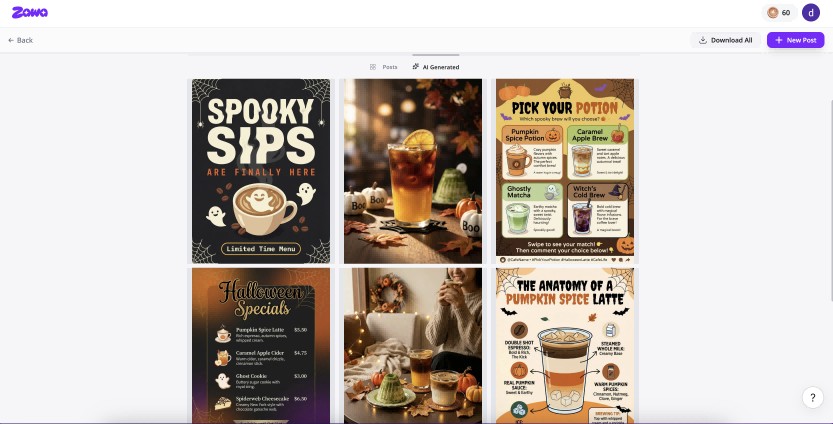
For a team posting five to seven times a week, that replaces the back-and-forth between a brief, a designer, and a copywriter. One photo goes in. A week of Facebook-ready content comes out. At the same time, Zawa can also create Facebook-related visuals such as profile pictures, Facebook banners, and other branded social media content.
Distribution Strategy: Amplifying Reach Beyond the Feed
Facebook groups as a distribution channel
Facebook Groups reach communities the standard feed algorithm does not. The Facebook group marketing strategy that works is straightforward. Join groups where your audience is already active. Spend a few weeks contributing useful answers. Then share your page posts only when they directly fit the conversation.
Hard promotion in Groups gets removed by admins and flags your account. Consistent value contributions get your posts pinned and recommended. The conversion path is longer but the trust level is higher.
Running your own Group also works, but it requires active moderation and a content plan. A Group that goes quiet for two weeks loses momentum that takes months to rebuild.
Instagram and WhatsApp: Extending what Facebook starts
Facebook and Instagram share the same ad infrastructure and audience data. A Reel posted to Instagram can be cross-posted to Facebook automatically. The same creative can perform differently on each platform, so track results separately rather than assuming what works on one works on the other.
WhatsApp fits into the distribution stack at the retention end. After someone engages with your Facebook content, a WhatsApp Business link in your bio or post gives them a lower-friction way to start a conversation than a website form. The WhatsApp catalog feature also lets customers browse products inside the chat window.
This is central to marketing strategy in Facebook's broader ecosystem. Meta connects all three platforms through shared pixel data. An audience built on Facebook can be retargeted on Instagram and followed up through WhatsApp messaging campaigns.
Audience Behavioral Insights: Driving Performance with Active Engagement
Using Meta insights to improve posting decisions
Meta Insights shows when your audience is online, which formats drive the most reach, and where followers are located. The Active Times data is the most useful starting point. Post 30 minutes before your audience's peak activity window. That gives the algorithm time to index your content before traffic spikes.
Content Type Performance is the metric most pages overlook. It breaks down reach, engagement, and link clicks by format. If carousels generate three times more saves than static posts, shift production time toward carousels. Follow the data, not your assumptions.
Check these metrics weekly, not monthly. A week is enough data to confirm whether a format change is working. A month means you have wasted three weeks posting the wrong content.
Why replying in the first hour affects reach
Reply to comments within the first hour after posting. The algorithm tracks how fast a conversation develops, not just how many comments a post eventually gets. A post with 10 comments and 5 replies from the page in the first hour will outrank one with 30 comments that sat unanswered until the next day.
This window also drives secondary reach. When you reply to a comment, the interaction shows up in that commenter's friends' feeds. Your reply extends visibility without any added spend.
Paid Growth: Facebook Ads for Scalable Results
Boosted posts vs. Ads manager
Boosting a post is the fastest way to extend reach on content that is already performing. Setup takes two minutes. Targeting is basic. It works well for local awareness and event promotion. The limit is that boosted posts have fewer optimization options than a proper Ads Manager campaign.
Ads Manager is where a serious Facebook and marketing strategy gets built. It lets you set specific objectives: traffic, conversions, or lead generation. You control audiences, placements, and creative tests. The complexity is higher, but so is precision.
For beginners: boost your three best-performing organic posts per month while you learn Ads Manager. That keeps growing without requiring full campaign management skills on day one.
How the Meta pixel and A/B testing work together
The Meta Pixel is a code snippet placed on your website. It tracks which pages visitors view, how long they stay, and whether they buy. That data feeds into Facebook's retargeting system. You can serve ads to people who visit a product page but do not complete a purchase.
A/B testing works at the creative level. Run two versions of the same ad with one variable changed: the headline, the image, or the call-to-action. Let each version reach at least 1000 impressions before comparing. The version with the lower Cost-Per-Click is the one to scale. Reading results before that threshold produces misleading data.
For Facebook affiliate marketing, the Pixel is especially important. Tracking which affiliate traffic converts lets you double down on the content formats and audiences that actually produce commissions rather than guessing. Affiliate marketing via Facebook works best when the landing page and the ad creative speak to the same specific problem, so the Pixel data helps you see exactly where the audience drops off.
Analysis and Iteration: Tracking Your Path to Success
The metrics that actually measure strategic health
Follower count and post likes are not performance indicators. The metrics that reflect actual strategy health are Return on Ad Spend (ROAS), Customer Acquisition Cost (CAC), and engagement rate by reach.
ROAS tells you how much revenue each ad dollar generates. A 3x ROAS means $3 back for every $1 spent. CAC tells you what each new customer costs to acquire. If your margins cannot cover that cost, the strategy does not work regardless of how good the content looks.
Engagement rate by reach beats raw engagement numbers as a quality signal. A post with 200 likes from 5,000 reach has a 4% rate. The same 200 likes from 50,000 reach gives you 0.4%. The first post is doing more work, even though the like count looks identical.
A monthly review habit that prevents plateaus
At month end, pull data on your top three and bottom three posts by reach and engagement rate. Look for what the top performers share: format, topic, time of day, hook style. Then look at what the bottom performers share. That pattern tells you what to change next month.
Do the same with paid campaigns. Pause the ad sets with the highest CPC and lowest conversion rate. Increase budget on the ones with the lowest CAC. Do not make changes mid-month without enough data. Let campaigns run for at least seven days before adjusting.
This monthly audit is what separates accounts that grow from accounts that plateau. Consistent review and adjustment beats any single tactic in a Facebook marketing strategies playbook.
Conclusion
Facebook marketing strategy in 2026 runs on three things: consistent organic content, data-driven ad spend, and active community management. Reels build reach. The 80/20 content mix builds trust. Paid campaigns scale what is already working. No single tactic does all of that on its own.
The audit habit matters as much as any individual tactic. Accounts that review their data monthly and adjust their content and budget accordingly consistently outperform those that set a strategy once and leave it running.
Start with three to four posts per week. Track your best performers in Insights. Run one boosted post per month before moving to Ads Manager. Add the Pixel to your site from day one. Retargeting data needs time to build. Each of those steps compounds over time, and that compounding is where growth actually comes from.
Frequently Asked Questions
What is the best Facebook marketing strategy for small business?
A Facebook marketing strategy for small business should prioritize organic reach before paid spend. Post three to five times a week using Reels, carousels, and static images. Apply the 80/20 rule: 80% value, 20% promotion. Join two or three relevant Groups and contribute before linking to your page. Once you find your top-performing posts, boost them with a small daily budget.
How often should I post on Facebook for marketing?
Three to five times per week is enough for most accounts to maintain algorithm favor without burning out the content team. Consistency matters more than frequency. An account that posts five times Monday and nothing for the next six days will underperform one that posts once daily. Spacing posts at least four hours apart also helps each piece get its own distribution window.
What type of content performs best on Facebook?
Reels generate the widest organic reach for new accounts. Carousels drive the most saves and profile visits. Polls and questions drive the most comments. The highest-performing pages mix all three across the week rather than committing to one format. Reels under 30 seconds with a strong two-second opening consistently outperform static images for reach in 2026.
What is the 20% rule on Facebook?
The 20% rule came from Facebook's old guideline that ad images could contain no more than 20% text. That rule was officially relaxed. But the principle holds: heavy text in images reduces delivery and engagement. The more useful 80/20 rule for content is this: 80% of posts provide value with no sales ask, 20% are promotional. Zawa can help brands create a more balanced mix of “80% value-driven content and 20% promotional content” based on their specific needs.
What is the 3 2 2 Facebook ad strategy?
The 3 2 2 structure is three audiences, two ad sets per audience, and two creative variations per ad set. The point is to generate real data across segments rather than guessing which audience will perform best. Give each variation seven days and at least 1000 impressions. Once you have results, cut the underperformers and move budget to whatever produced the lowest CPC.
You May Be Interested
140+ Facebook Bio Ideas: Short, Professional, Unique, and More

50+ Mother’s Day Post Ideas for Instagram, Facebook & More

4 Ways To Remove Backgrounds from Photos

Product Photography-How to Take Product Photos

20 Best AI Marketing Tools You Should Know in 2026

18 Best AI Tools for Small Businesses That Save Time and Cut Costs
