US Menu Labeling Laws: Calories, Allergens & Requirements
Learn how US menu labeling laws apply to restaurant chains, calorie counts, allergen disclosures, online menus, and recordkeeping. See federal 20-location rules, exemptions, state differences, and practical steps for keeping menu information accurate.

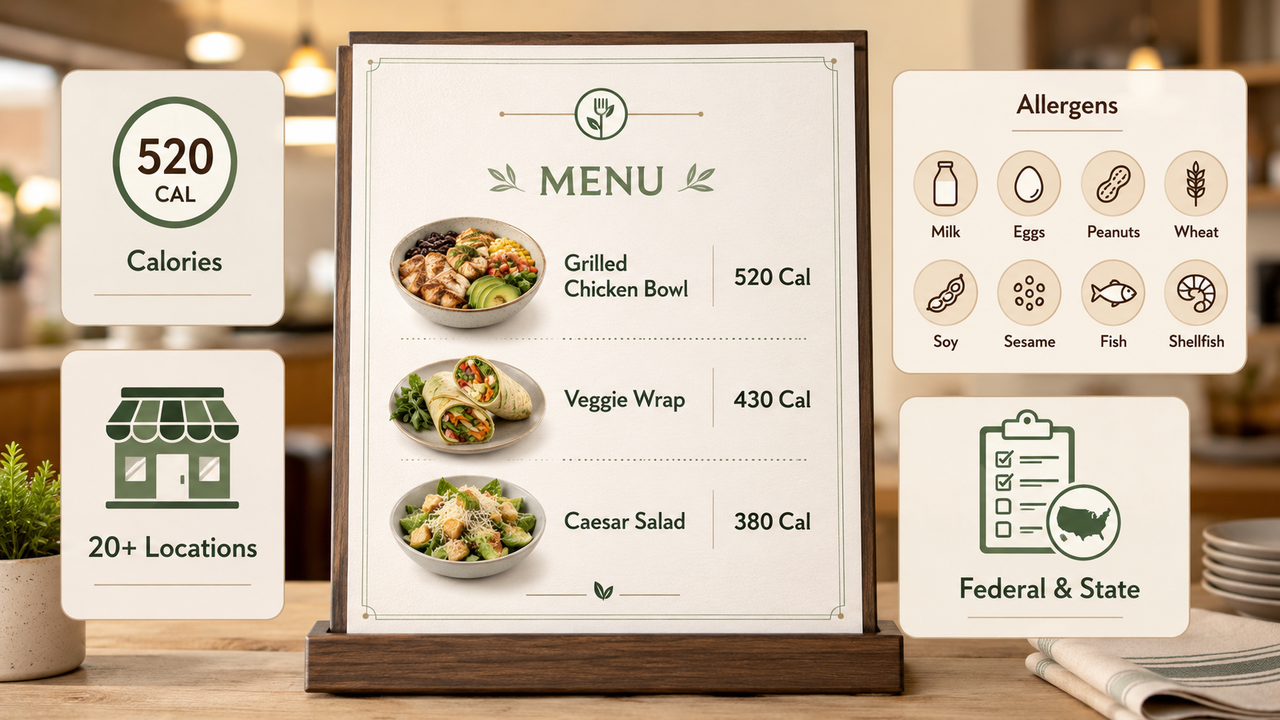
US menu labeling laws require certain large restaurant chains to show calories and provide more nutrition information when customers ask. Smaller restaurants usually fall outside the federal rule, but state or local requirements may still apply. Calorie rules and allergen rules also come from different laws.
What Are Menu Labeling Laws?
Menu labeling laws set rules for the nutrition or allergen information shown where customers choose food. The main federal rule appears in 21 CFR 101.11 and has been applied since May 7, 2018. It covers standard menu items sold by qualifying restaurants and similar retail food establishments.
How Menu Labeling Laws Work in the US
The federal rule focuses on information available before the order. A covered menu must show calories for standard items, and the restaurant must tell customers that more nutrition information upon request.
The rule can apply to printed menus, drive-through boards, electronic menus, and online menus. The same item may also appear in food advertising, so its price, description, and nutrition claims should remain consistent across customer-facing channels. Food on a buffet or another self-service area follows separate placement rules because customers choose it near the display.
Federal Laws vs State Requirements
Federal menu labeling creates one national nutrition standard for covered chains. States and cities may still regulate restaurants outside the federal rule or require other types of information.
California now requires certain large chains to disclose major allergens in menu items. Massachusetts uses a different approach and requires a menu notice asking customers to tell the server about food allergies.
Location matters even when the federal calorie rule does not apply.
Who Must Follow Menu Labeling Laws?
A restaurant is covered only when it meets every federal condition. Store count alone does not decide the answer.
The FDA 20-Location Rule
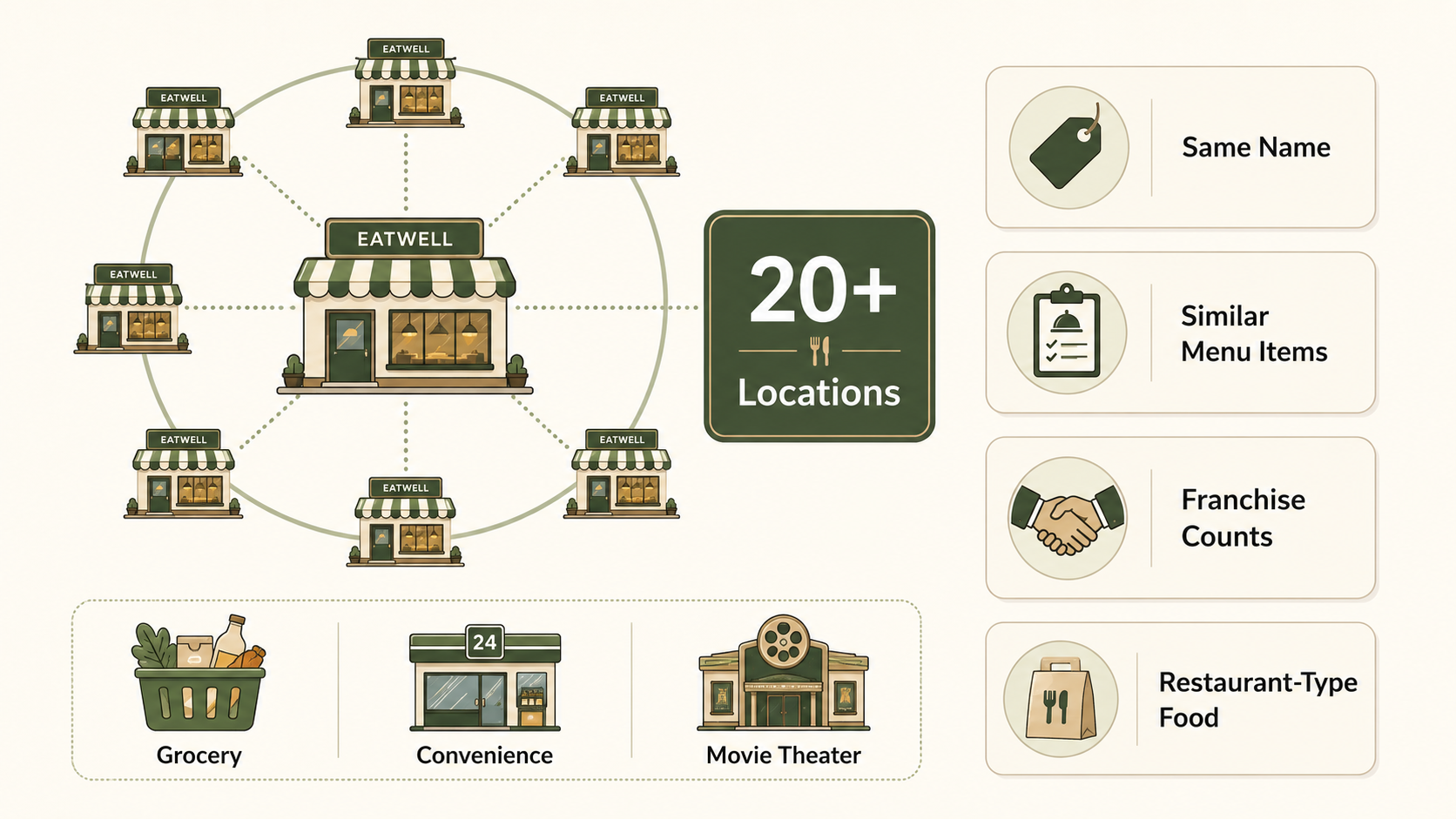
The federal rule applies to a chain with 20 or more locations. Those locations must operate under the same name and offer substantially the same menu items. Franchise locations may count toward the chain even when separate franchisees own them.
A grocery store, convenience store, movie theater, or similar business can also fall under the rule when it meets the federal definition and sells restaurant-type food.
| Federal test | What it means |
| 20 or more locations | The chain has at least 20 qualifying locations |
| Same name | Customers see the same name or a minor variation |
| Similar menu | Locations sell substantially the same standard items |
| Restaurant-type food | Food is usually eaten soon after purchase |
Rules for Independent Restaurants
An independent restaurant with fewer than 20 locations is generally outside the federal menu labeling rule. It may still choose to display calories, but any nutrition claims should have a reliable basis.
An establishment may voluntarily register with the FDA and follow the federal requirements. Registration must be renewed every other year.
State and local rules may reach smaller restaurants. Each location should check its health department requirements, especially those covering allergen notices and unpackaged food.
What Must Be Shown on a Restaurant Menu?
Covered restaurants must place the required information where customers can use it before ordering. The rule also sets visibility standards.
Calorie Counts and Required Statements
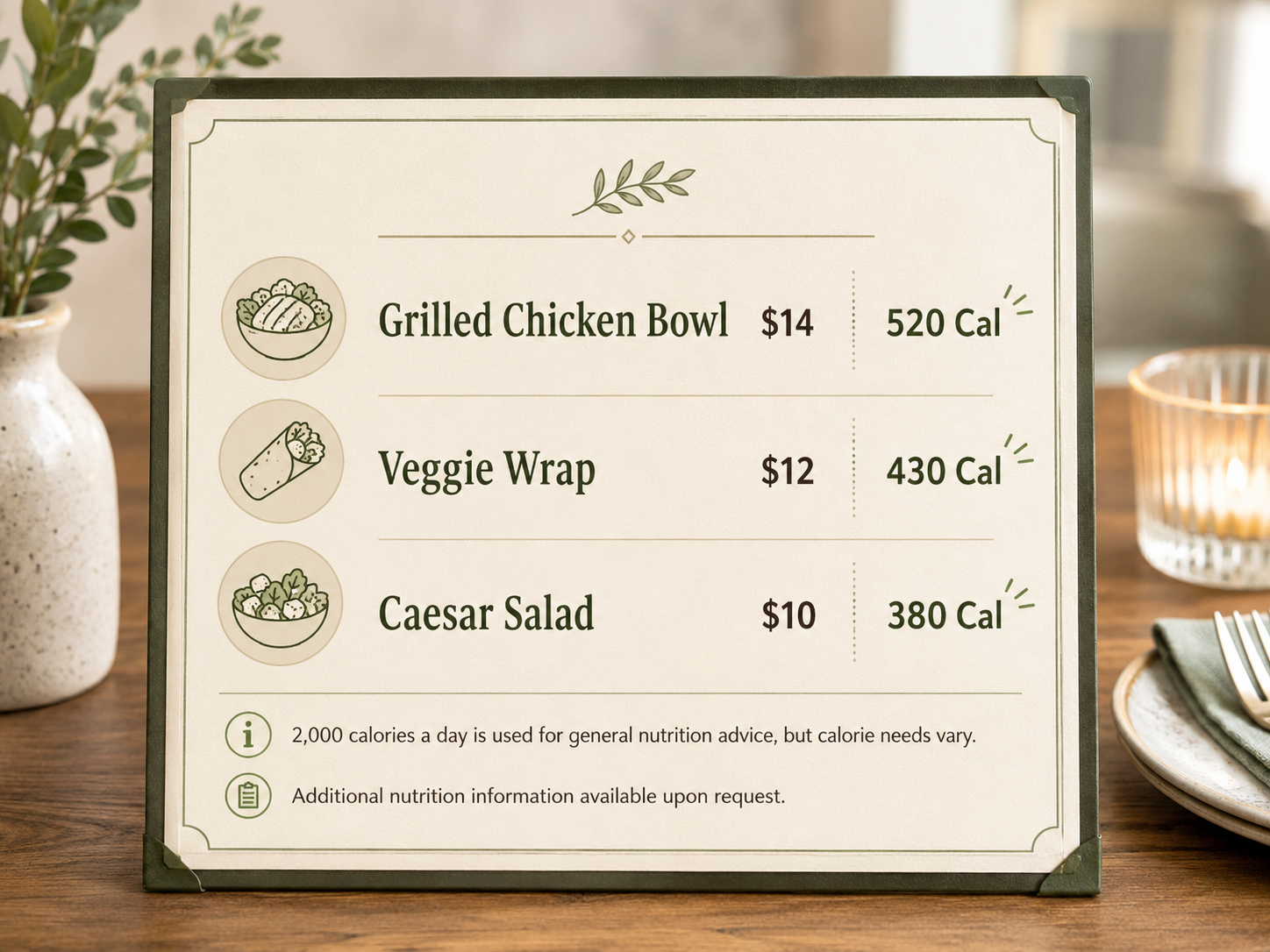
Calories must appear next to the item’s name or price, and the type cannot be smaller than either. Clear typography and visual hierarchy matter because the calorie number must remain easy to identify without competing with the item name, price, or description. The menu must use the word Calories or Cal so customers understand the number.
Two statements are required. One explains that 2,000 calories a day is used for general nutrition advice and that calorie needs vary. The second tells customers that additional nutrition information is available upon request.
Self-Service Foods and Items on Display
Buffets, salad bars, bakery cases, and self-service drink stations need calorie information close to the food. The sign should state calories per item or per serving. The serving unit should also be clear, such as per scoop or per muffin.
For larger displays, the choice between a poster and flyer format depends on the viewing distance and the amount of information customers need to read. One sign may cover several foods when customers can clearly match each calorie number to the item. Packaged food may place the calorie information on the package when the label is visible before purchase.
Nutrition Details Customers Can Request
A covered restaurant must keep written nutrition information available on the premises. Customers do not need to explain why they want to see it. The information may appear in a handout, binder, poster, menu, or electronic device that customers can review at the restaurant.
The federal rule requires the following information for each standard menu item.
| Required written information | Unit |
| Total calories and calories from fat | Calories |
| Total fat and saturated fat | Grams |
| Trans fat | Grams |
| Cholesterol and sodium | Milligrams |
| Total carbohydrate and dietary fiber | Grams |
| Sugars and protein | Grams |
Rules for Online Menus and Menu Boards
An online page can count as a menu when customers use it to choose food and order by phone. A separate nutrition page does not replace calorie information beside each standard menu item. Calories should remain easy to read even when the page includes food photography, promotions, or ordering buttons.
Electronic menu boards follow the same rules as printed menus. The calorie number must remain linked to the item when screens rotate or prices change.
Which Menu Items Are Exempt?
The federal rule does not cover every food sold by a qualifying chain. Common exemptions include daily specials, custom orders, general-use condiments, and temporary items offered for fewer than 60 total days during a calendar year.
A market test item can be exempt when it is offered for fewer than 90 consecutive days. The exemption may end when the food becomes a regular menu item.
Do Restaurants Need to List Allergens?
There is no single federal rule requiring every US restaurant to print the allergens beside every dish. Federal packaged food allergen laws and federal restaurant calorie laws cover different products and disclosures.
The Big 9 Food Allergens
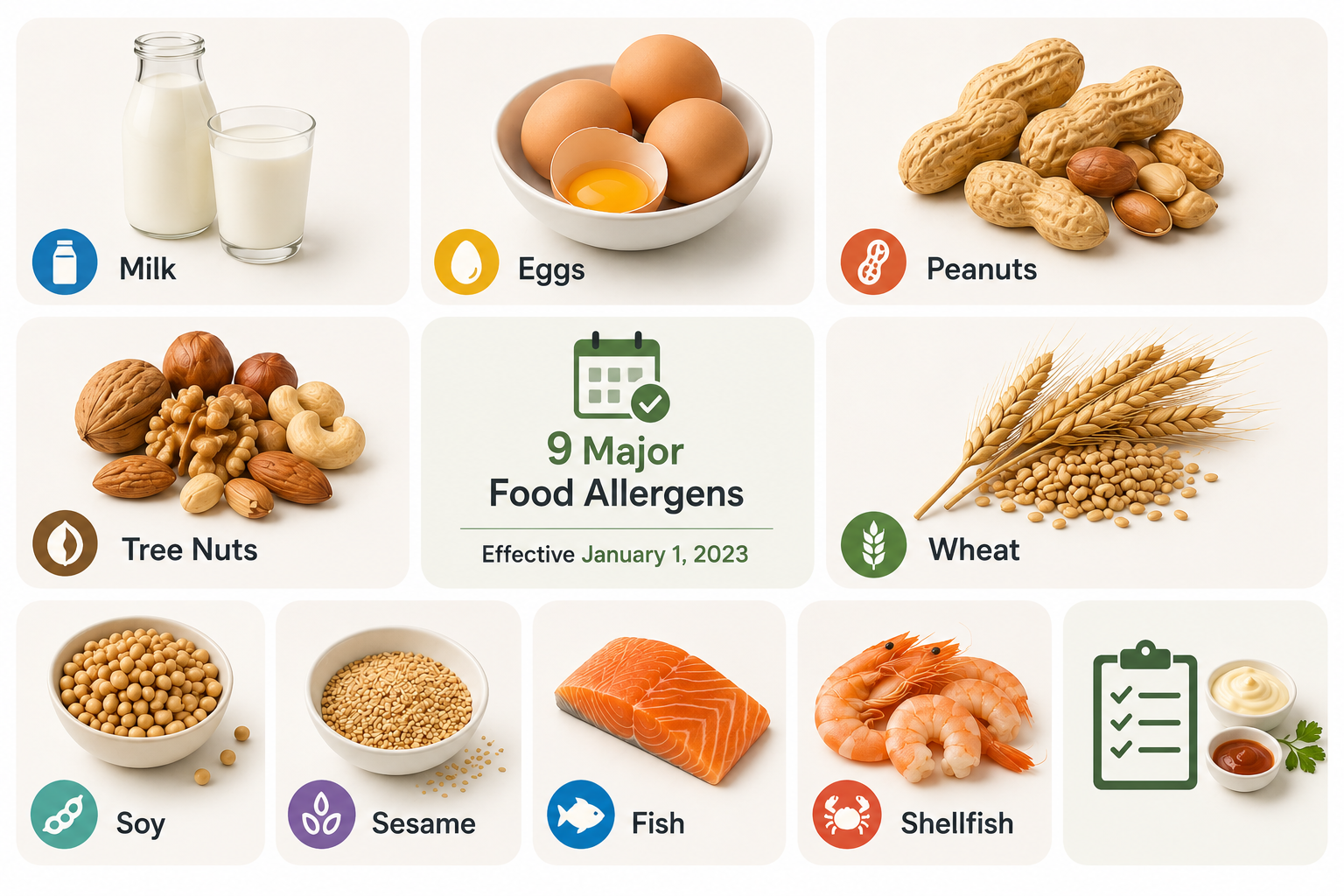
US law recognizes nine major food allergens. Sesame became the ninth major allergen on January 1, 2023.
An allergen may enter a dish through a sauce, topping, seasoning mix, or supplier ingredient. Ingredient records should identify the food source rather than relying only on a product brand.
| Major allergen | Common menu sources |
| Milk | Cheese, cream, butter |
| Eggs | Mayonnaise, batter, pasta |
| Fish | Salmon, cod, fish sauce |
| Crustacean shellfish | Shrimp, crab, lobster |
| Tree nuts | Almonds, walnuts, pecans |
| Peanuts | Peanut sauce and some desserts |
| Wheat | Bread, noodles, flour |
| Soybeans | Tofu and soy sauce |
| Sesame | Tahini, seeds, sesame oil |
What Federal Allergen Rules Cover and Do Not Cover
Federal allergen labeling laws mainly require major allergens to be identified on packaged foods regulated by the FDA. They do not create a nationwide item-by-item allergen menu rule for every restaurant.
The FDA Food Code recommends written allergen information for certain unpackaged foods. The Food Code is a model that states and local governments may adopt into their own rules.
A restaurant therefore, needs to check both federal requirements and the law in the state where the food is sold.
State Allergen Laws for Restaurants
California SB 68 took effect on July 1, 2026. It applies to food facilities already covered by the federal menu nutrition rule. They must disclose major allergens that are known, or reasonably should be known, to be ingredients in each menu item. The information may appear directly on the menu or through an allowed digital format.
A California restaurant using a QR code must provide a non-digital option. This may be an allergen menu, chart, grid, or booklet. Standardized allergen pictograms are also permitted.
Massachusetts requires a clear menu notice asking customers to tell the server about food allergies before ordering. These different approaches explain why one national menu may need local versions.
How to Keep Menu Labels Accurate
Accurate labels depend on the food that is actually served. A correct calculation can become outdated when a portion changes or a supplier replaces an ingredient. Digital systems and other uses of AI in the food industry can support recipe records, menu updates, and visual production, but they do not replace a documented nutrition calculation or legal review. The recipe, preparation method, and menu information should remain connected.
Standardized Recipes and Portions
Write one approved recipe for every standard menu item. Record ingredient brands, exact amounts, cooking yield, and the portion served to one customer.
Use the same scoops, cups, or scales at each location. Staff should also know which substitutions need approval because an ingredient change may affect calories or allergens.
Choose a Reliable Way to Calculate Calories
FDA rules allow several reasonable methods. A restaurant may use a recognized nutrient database, recipe analysis software, a published cookbook, laboratory analysis, or nutrition facts from packaged ingredients.
The suitable method depends on the food. Laboratory testing may help with complex recipes, while database analysis can work for standardized dishes made from measured ingredients.
Document every input and use the same calculation method when the recipe is reviewed again.
Build a Menu Allergen Matrix
Create a table with menu items in rows and the Big 9 allergens in columns. Mark confirmed ingredients using approved recipes and current supplier documents. Keep possible cross-contact information in a separate field. This prevents it from being confused by an allergen that is an intentional ingredient.
Each entry should name its source. A supplier specification, package label, or written recipe provides stronger support than staff memory.
Update Menus When Recipes Change
When a recipe, price, or allergen note changes, update the menu layout at the same time. A flexible online menu design tool can turn revised dish details into a polished, editable menu without requiring advanced design skills.
Restaurant teams can change the text, images, colors, and layout for print or digital use. Verify every calorie and allergen entry first. The tool supports menu design and does not determine whether the information meets legal requirements.
Keep Records That Support Your Menu Claims
The FDA may ask a covered establishment to provide information supporting its nutrient values. Keep the recipe, ingredient data, calculation worksheet, and review date for each standard menu item. When a nutrient database is used, record its name and version.
Records should also show that the served portion and preparation match the calculation. The federal rule may require signed statements from a responsible person confirming that the information is complete and accurate.
FAQs
Do Alcoholic Drinks Need Calorie Labels?
Yes, when the drink is a standard item on a covered menu. Alcohol displayed away from a menu may follow different rules, but a listed beer, wine, or cocktail generally needs a calorie count.
Can Restaurants Use Allergen Icons or QR Codes?
Sometimes. Federal calorie counts cannot be replaced by a QR code. California allows standardized allergen icons or digital disclosure, but customers must also have access to a non-digital version.
Can Restaurants Follow the Menu Labeling Laws Voluntarily?
Yes. An establishment outside the federal rule may register with the FDA and follow 21 CFR 101.11. The registration must be renewed every other year.
Who Enforces Menu Labeling Laws?
The FDA enforces the federal menu nutrition rule. State and local agencies may enforce their own restaurant requirements, including state allergen laws.
What Happens If Menu Labels Are Wrong?
Incorrect required nutrition information may make food misbranded under federal law. The FDA may request supporting records, require corrections, or take further action. State violations may have separate consequences.
Conclusion
Menu labeling laws give customers calorie information when they choose food and access to more nutrition details when requested. The federal rule mainly covers chains with 20 or more locations, while smaller restaurants depend more on state and local law.
Allergen disclosure is changing faster than calorie labeling. California now requires item-level Big 9 disclosures for covered chains, while other states use menu notices or food safety rules.
Check the requirements for each location. Calculate nutrition information from controlled recipes and update every menu format whenever the food changes.
You May Be Interested

100+ Good Quotes for Instagram Bio (Copy & Paste Ideas)

150+ Instagram Bio Ideas for Moms

How to Take a Passport Photo with an Iphone

How Automatic Prompt Engineering Works

8 Best Image Extender Tools: The Ultimate AI Photo Background Expanders