
What Is an 8K Resolution? 8K UHD Explained
This guide explains 8K resolution, including its 7680 × 4320 pixel dimensions, benefits for large screens and video editing, and differences from 4K and 1080p. It also helps viewers decide whether 8K is worth buying in 2026 for typical home viewing.

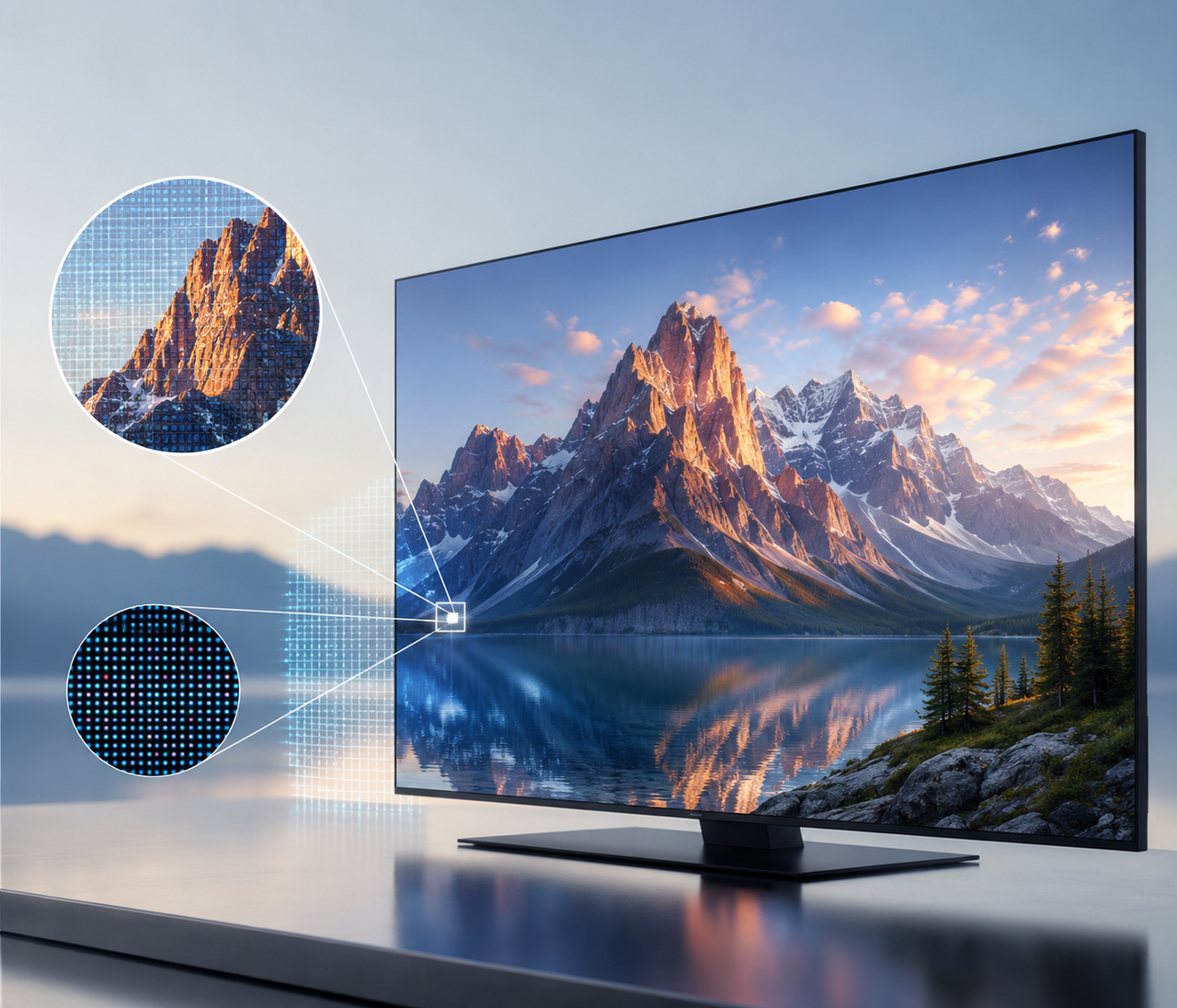
8K resolution usually means a 7,680 × 4,320 image with about 33.2 million pixels in each frame. It gives TVs and video files four times the pixel count of 4K UHD and sixteen times that of 1080p. Those extra pixels can preserve finer detail and provide more room for cropping. The benefit is easiest to notice on very large screens, at shorter viewing distances, or in production workflows that use native 8K footage. For most homes in 2026, however, 4K remains the more practical choice because compatible content is limited and overall picture quality depends on far more than resolution alone.
What Is the 8K Resolution?
8K belongs to the Ultra High Definition television system defined by ITU standards. The format uses a 16:9 frame and progressive scanning, which makes it compatible with the shape used by most modern TVs and online video players.
What Does 7680 × 4320 Mean?
The number 7,680 describes the pixels arranged across the image. The number 4,320 describes the vertical pixel rows. Multiplying those dimensions gives 33,177,600 pixels per frame. Each pixel stores part of the image, so a higher pixel count can represent finer edges and smaller textures when the source contains enough detail.
Resolution only measures the pixel grid. It does not measure brightness, contrast, color accuracy, motion handling, or compression quality. Two displays with the same 8K resolution can therefore produce very different pictures.
Why Is 8K Also Called 4320p?
4320p refers to the 4,320 vertical pixel rows. The letter “p” indicates progressive scanning, which displays every line as part of each complete frame.
The naming pattern also appears in 1080p and 2160p. Consumer marketing favors 8K because the horizontal dimension is close to 8,000 pixels. YouTube lists the same format as “4320p (8K)” in its official resolution guide.
Is 8K UHD the Same as DCI 8K?
No. 8K UHD measures 7,680 × 4,320 and uses a 16:9 aspect ratio. Camera manufacturers may use the name 8K DCI for an 8,192 × 4,320 recording mode with a wider 17:9 frame.
Canon, for example, lists both formats separately on the EOS R5. Its 8K UHD mode records at 7,680 × 4,320, while the 8K DCI mode records at 8,192 × 4,320.
The term 8K DCI requires some care. The current Digital Cinema Initiatives specification defines 2K distribution at 2,048 × 1,080 and 4K distribution at 4,096 × 2,160. It does not define an official 8K theatrical distribution format. In normal camera use, 8K DCI describes the wider acquisition frame rather than a separate DCI cinema delivery standard.
Where Is 8K Resolution Commonly Used?
8K has not become a general replacement for 4K. It appears in a smaller group of products and workflows where extra image area has a clear purpose.
8K TVs and Home Entertainment
Consumer 8K TVs display 7,680 × 4,320 pixels. Current models are concentrated in larger screen sizes because the higher pixel density is harder to appreciate on a small television.
Native 8K movies and shows remain scarce. A 2026 RTINGS review found only a small number of currently available 8K TV models and noted that most material shown on them must be upscaled. YouTube videos and a limited number of games account for much of the accessible native content.
An 8K panel can still show lower-resolution material. The television scales the incoming frame to fill its native pixel grid. Final quality depends on both the source and the TV’s image processor.
8K Cameras and Post-Production
There are some mirrorless and cinema cameras that can record in 8K. These are typically high-res files used for production rather than for delivery in 8K.
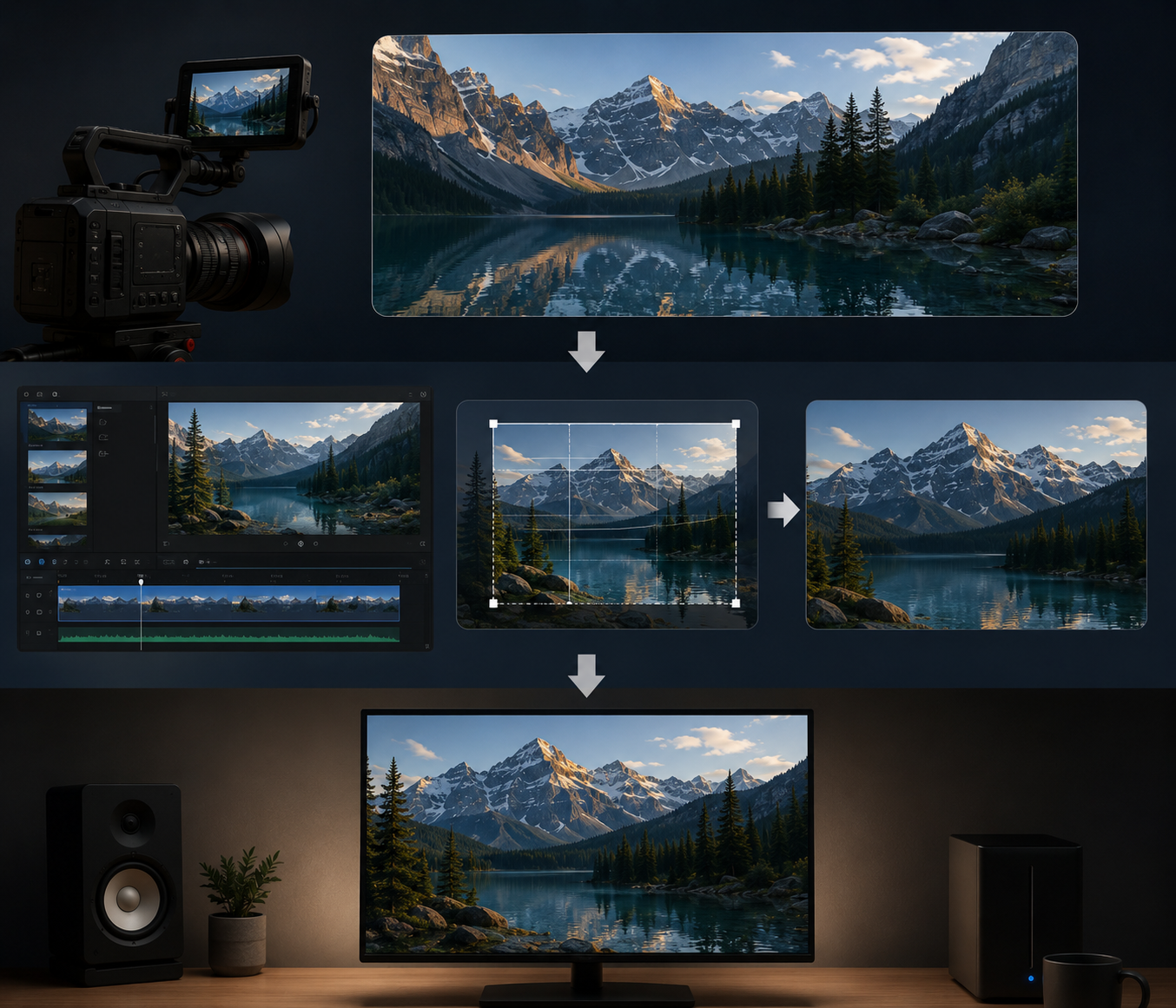
Editors are able to crop into a portion of the 8K frame and still have enough pixels left over for a 4K timeline. Digital image stabilization takes advantage of the extra image area, as the software can shift the frame without revealing empty edges right away.
The larger files create a heavier workload. Storage fills faster, decoding requires more processing power, and smooth timeline playback can become difficult. Adobe recommends proxy workflows for demanding footage. The editor works with smaller temporary copies, then reconnects the original files during final export. The online tools can also benefit it a lot.
8K Online Video and Playback
YouTube accepts 7,680 × 4,320 uploads for its standard 16:9 player. Actual 8K playback still depends on the video, browser, display, hardware decoder, and connection speed.
The resolution label does not reveal how much data was retained during compression. A heavily compressed 8K stream can show block patterns or lost texture. A carefully encoded 4K version may look cleaner.
Specialized Displays and Visualization
8K is also used in selected digital signage, presentation walls, simulation systems, and professional visualization displays. These installations may place viewers near a large image or show detailed material across a wide surface.
Compatibility must be checked throughout the signal path. HDMI 2.1 supports formats up to 8K at 60 Hz with an appropriate device configuration. Certified Ultra High Speed HDMI cables support bandwidth up to 48 Gbps, while the newer HDMI 2.2 specification expands the available bandwidth further.
How Does 8K Compare to Other Resolutions?
The leap to 8K alters the quantity of pixels that can be stored or shown. How useful those pixels are really depends on how the video was shot and where it will be viewed.
8K vs 4K: How Big Is the Difference?
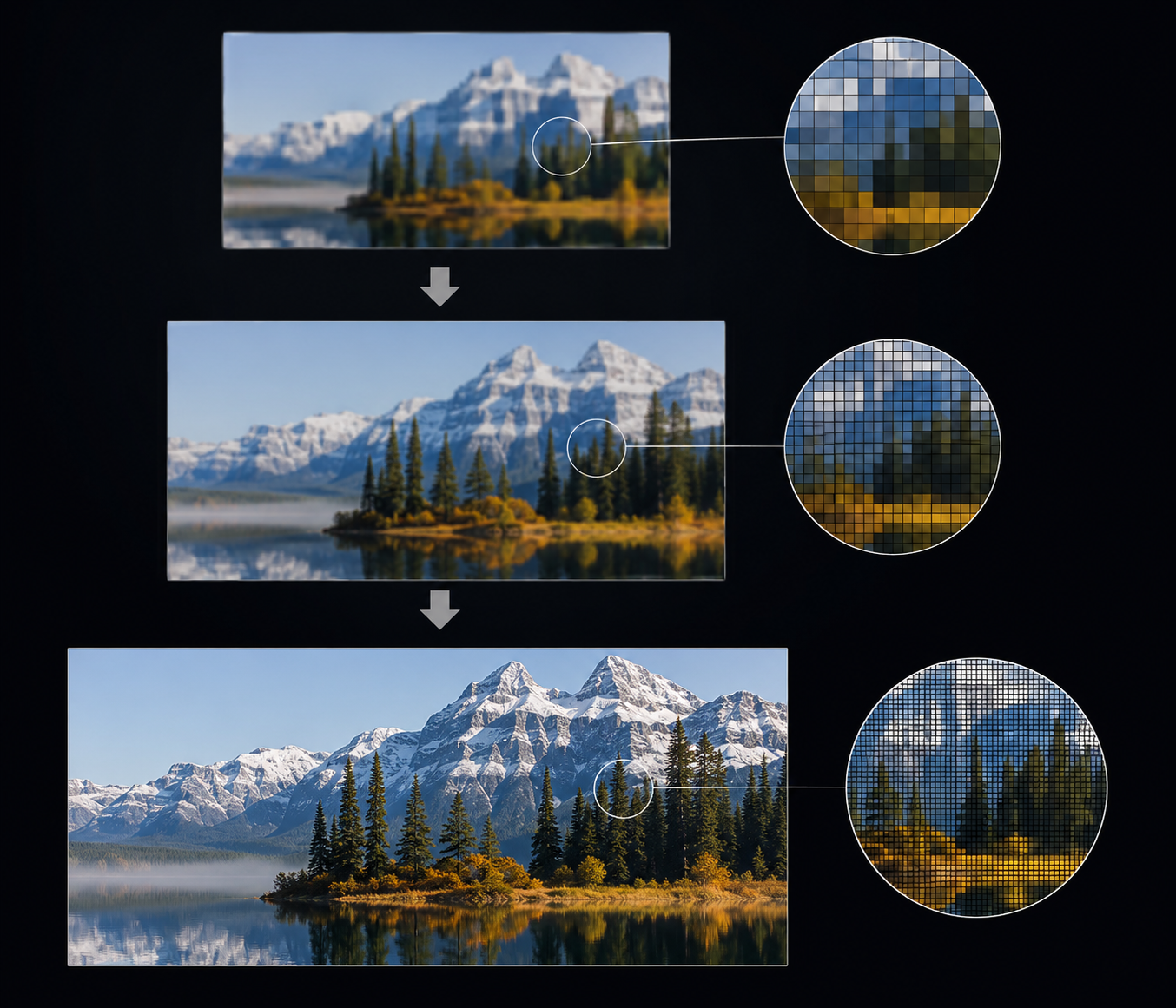
8K doubles both dimensions of 4K UHD. That produces four times as many pixels in each complete frame. This difference gives editors more space for cropping. It can also keep pixels less visible on an unusually large screen. For a viewer sitting several feet from a typical television, the improvement may be difficult to detect.
The comparison becomes clearer after understanding what 4K resolution means. A 4K UHD frame already contains more than eight million pixels, which is enough to produce a sharp image on many household TV sizes.
8K vs 1080p: How Many More Pixels?
8K has sixteen times as many pixels as 1080p. 8K has four times the width and four times the height of 1080p, resulting in sixteen times as many pixels overall. The gap is more noticeable than the 4K to 8K difference was, particularly on a large screen. Still, a native 1080p source doesn't suddenly contain sixteen times more captured detail when it's blown up. Upscaling has to infer the missing extra pixel values.
The 1080p vs 4K comparison covers the relationship between the lower formats. It helps show why every resolution increase demands more storage and processing.
8K, 4K, and 1080p at a Glance
| Format | Dimensions | Total Pixels | Aspect Ratio | Typical Use |
| 1080p Full HD | 1,920 × 1,080 | 2,073,600 | 16:09 | Broadcast video, web video, smaller screens |
| 4K UHD | 3,840 × 2,160 | 8,294,400 | 16:09 | TVs, streaming, games, consumer recording |
| 8K UHD | 7,680 × 4,320 | 33,177,600 | 16:09 | Large premium TVs, high-resolution capture, specialized displays |
These values describe spatial resolution. They do not include frame rate, color depth, dynamic range, or bitrate.
Can You Really See the Difference with 8K?
Sometimes. Screen size and viewing distance determine how much of the extra resolution reaches your eyes.
Does Screen Size Make 8K Look Better?
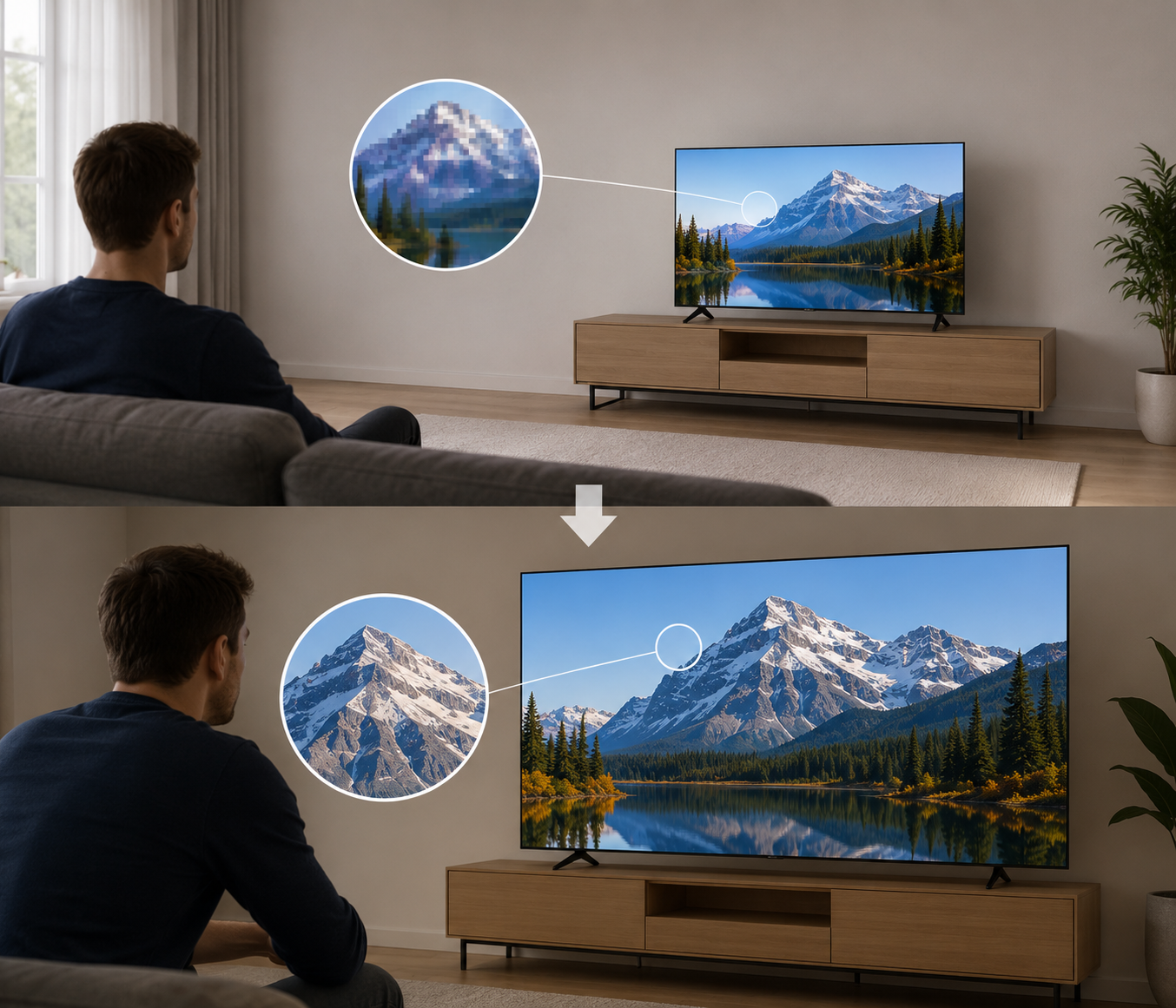
The size of each pixel physically varies with the screen. A fixed resolution is stretched over a larger area on a bigger panel, which makes the individual pixels more visible from the same distance. An 8K panel makes pixels smaller than a 4K panel of the same size. This benefit is more pronounced the larger the display. And it’s a factor when the viewer is close, as with a desktop display or a screen for detailed visualisation.
Resolution is diminishing returns when the pixels are so small the viewer can’t see them. So, contrast and image processing can influence perceived quality more at that stage.
How Far Should You Sit from an 8K TV?
Viewing distance should be based on screen height rather than one fixed number of feet. That method works across different television sizes.
A 2025 peer-reviewed study compared human visual limits with common display resolutions. Its model found little added benefit from 8K when the viewer sits farther than about 1.3 times the screen height. The exact limit varies with eyesight, image color, room conditions, and the type of detail being viewed.
Measure the visible height of the screen and multiply it by 1.3. Sitting much farther away reduces the chance of seeing additional 8K detail. This distance may feel unusually close for normal TV viewing, which explains why many living rooms show only a small sharpness difference between 4K and 8K.
Why 8K Does Not Always Mean Better Quality
An 8K export can still look soft. Poor focus, camera movement, low light, noise, and strong compression remain visible after the frame is enlarged.
Upscaling creates the extra pixels required by the output size. It can smooth edges and reduce visible pixelation, though it cannot recover every texture that the camera failed to capture. A clean native 4K recording may therefore look better than a damaged file exported at 8K.
You can improve video quality online by reducing visible noise, sharpening soft details, and balancing brightness and color. The tool analyzes the footage automatically, so no complex editing settings are required. Cleaning up the source first can produce a clearer, more natural result, although enhancing and upscaling lower-resolution footage will not make it identical to video captured in native 8K.
Is 8K Resolution Worth It in 2026?
8K can serve a specific purpose, but it is not a necessary upgrade for most households. Current content and hardware choices still favor 4K.
When Buying an 8K TV Makes Sense
An 8K television may suit someone who already records personal 8K footage or uses the screen for high-resolution computer work. Buyers seeking the largest premium screen may also consider it when price is less important.
Review the whole television before choosing. Black level, HDR performance, brightness, motion quality, and upscaling affect every program you watch. The resolution label covers only one part of the image.
Current US availability is narrow. RTINGS’ June 2026 guide lists two main recommended 8K models, both from Samsung, while its 4K coverage includes far more options.
When a 4K TV Is Still the Better Choice
A 4K TV is the better fit for mainstream streaming, movies, sports, and console gaming. The buyer gets a wider choice of screen technologies and price levels.
Most available programs are delivered at 4K or below. Choosing a better 4K panel can improve contrast or HDR more noticeably than moving to an 8K panel with weaker picture performance.
Normal seating distance also reduces the resolution advantage. The 2025 vision study found that the relationship between screen size and distance often places household viewers beyond the point where 8K adds visible detail.
When Creators Benefit from Shooting in 8K
Creators benefit when the extra frame area is used during editing. A single wide shot can produce several 4K crops. The editor may also straighten a tilted frame or apply stabilization with less risk of dropping below the delivery resolution.
Visual effects work can use the additional image data for tracking and detailed masks. Large commercial displays provide another valid reason to preserve the full frame.
These gains come with practical costs. The camera may have shorter recording limits, while the computer must decode larger files. Faster storage and proxy editing can keep the workflow responsive. Exporting every project at 8K is unnecessary when the final platform only needs 4K or 1080p.
A Simple Checklist Before Choosing 8K
Use these questions before paying for an 8K device.
Do you have native 8K footage that you regularly watch or edit?
Is the screen large enough for your seating distance?
Can your player, computer, connection, and cable carry the required format?
Would a higher-quality 4K product improve more aspects of the picture at the same price?
A clear yes to the first questions gives 8K a useful role. Uncertain answers usually point toward 4K.
FAQs
What Do You Need to Edit an 8K Video?
You need compatible editing software, fast storage, sufficient memory, and a capable graphics processor. Proxy files improve timeline performance by replacing the original footage with smaller editing copies until final export.
What Do You Need to Watch an 8K Video?
You need an 8K display, an 8K source, and compatible playback hardware. External 8K60 devices may also require a certified Ultra High Speed HDMI cable and supported ports.
What Is the Difference Between Native and Upscaled 8K?
Native 8K contains detail captured or rendered at 8K. Upscaled 8K begins with a smaller frame and generates extra pixel values through processing. Upscaling can improve presentation but cannot recreate every missing detail.
Conclusion
The 8K resolution is a doubled 4K resolution with 7680 × 4320 pixels that is four times the number of pixels in 4K UHD and sixteen times that in 1080p. That additional resolution can be useful on very large displays, in proximity viewing environments, or for editing where creators can crop, stabilize, or reframe footage. Still, 4K is the more sensible option for most homes in 2026 as there’s simply no standard 8K content yet, the necessary hardware is expensive, and the visual benefit might be too marginal to justify the upgrade for many sitting at arm’s length from their TVs.
A good 4K TV can beat a mediocre 8K one in picture quality too, as that’s only one factor of many, including contrast, brightness, color accuracy, motion handling, source quality and compression. If you find yourself working with native 8K footage regularly, plan to use an unusually large display, or just want a little more editing flexibility, grab 8K. Otherwise, a high-quality 4K TV remains the more practical choice for everyday viewing.
You May Be Interested

140+ Facebook Bio Ideas: Short, Professional, Unique, and More

100+ Funny Mother's Day Jokes That Will Make Mom Laugh

100 Short Success Quotes to Inspire Your Creative Journey

105 Independence Day Trivia Questions 2026

15 Top AI Art Generators to Create the Best Masterpieces
